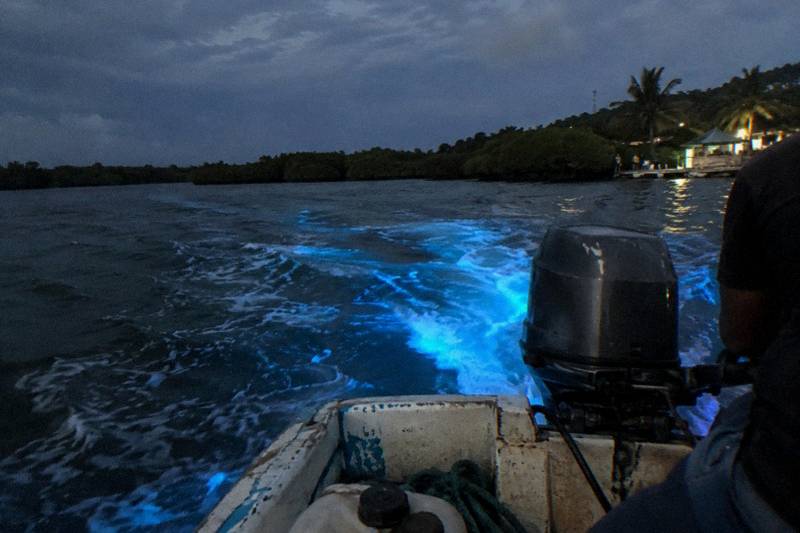
How Bioluminescence Works In The Luminous Lagoon
The glow in the Luminous Lagoon comes from a single-celled organism called Pyrodinium bahamense, and everything about a night trip there, from the moon to the rain, changes how brightly it shows.

Short answer
Bioluminescence in the Luminous Lagoon is produced by dinoflagellates called Pyrodinium bahamense, present at densities as high as 200,000 cells per litre in a 1966 study. They emit blue-green light when disturbed by boat wakes or swimmers. The brackish mix of Martha Brae River freshwater and Caribbean saltwater is what lets them thrive there.
Most night tours of the Luminous Lagoon follow the same arc: a boat slips out from Glistening Waters Marina near Falmouth, the engine churns the water, and the wake lights up blue-green behind the hull. Guests who swim, and many listings include a swim, come out of the water with ghostly trails around their arms. It looks like an effect someone switched on. It is not. It is the work of a microscopic organism that has been in this stretch of Trelawny marshland far longer than any boat tour, and once you know how it works, you also know why some nights outperform others and why this particular lagoon holds so much of it.
This guide explains the mechanism, the organism, the unusual estuary that concentrates it, and the natural factors that brighten or dim a visit. It closes with how the science maps onto the actual bookable trips, from the Montego Bay hotel-pickup boat tours to the Ocho Rios departures, because a reader who understands what they are looking at is in a much better position to pick the right night for it.
How Does Bioluminescence Work In The Luminous Lagoon?
Bioluminescence is light produced by a chemical reaction inside a living organism, and in the Luminous Lagoon the organism is a dinoflagellate called Pyrodinium bahamense, measured at densities as high as 200,000 cells per litre in a 1966 study. When a boat wake, a paddle or a swimmer mechanically disturbs the water, each cell flashes a short pulse of blue-green light. No heat, no electricity, no external light source, just chemistry triggered by movement.
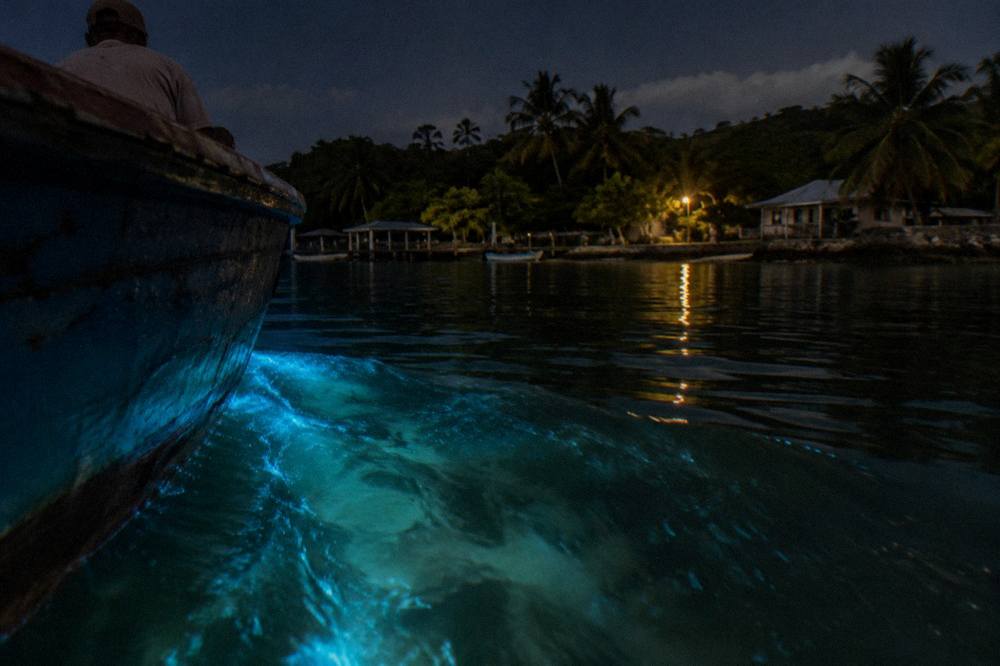
The reaction itself is common in the ocean. A light-producing molecule called luciferin is oxidised by an enzyme called luciferase, and the energy released leaves the cell as a photon rather than as heat. In Pyrodinium the flash peaks in the blue part of the spectrum, around 476 nanometres, which is why every description of the lagoon, from the operator's own scientific page to guest accounts, lands on the same blue-green colour. Blue travels furthest through water, so the emission colour is no accident of chemistry; it is close to what seawater transmits best.
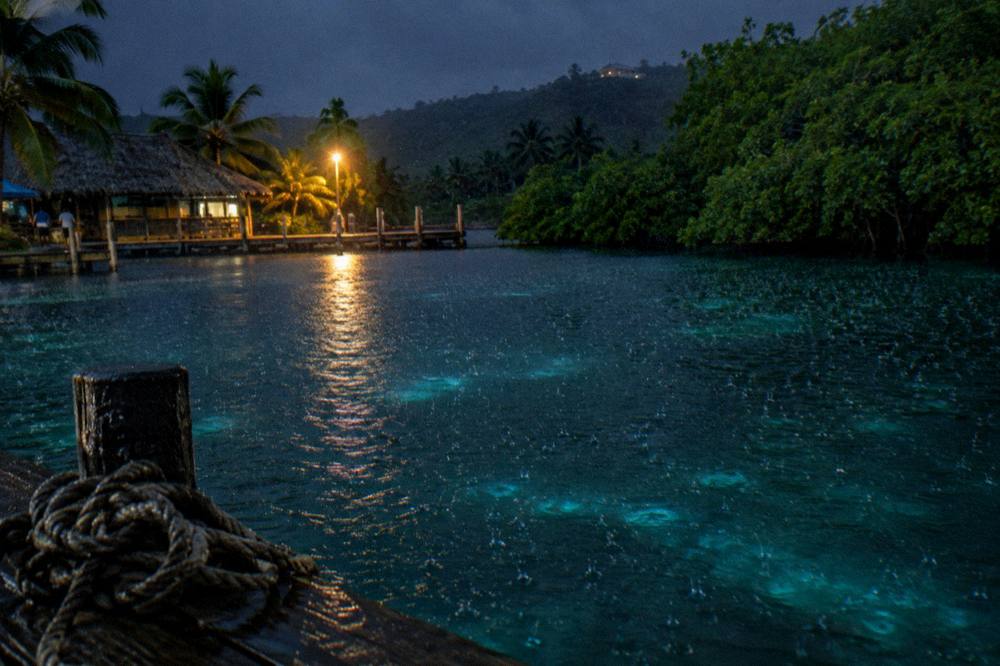
The trigger matters as much as the chemistry. The cells do not glow continuously like a lightbulb. They flash, briefly, when they are mechanically disturbed: a boat propeller, a hand dragged through the water, rain landing on the surface, a swimmer's kick. That is why a lagoon tour is built around movement. The boat's wake is effectively a moving brush painting a line of triggered cells, and when the boat stops and swimmers slip in, every stroke produces its own halo. On nights with rain, guests report that drops striking the water make small points of light, a visual effect distinct from the question of overall intensity.
A Johns Hopkins study of the bay, published in the Journal of Marine Research in 1966, identified the species and measured cell densities up to 200,000 per litre, work still cited in the operator's own scientific information page. For a fuller walk-through of the species and its relatives across the region, see the background on Pyrodinium bahamense and the site's companion piece on Jamaica's bioluminescent bay.
The pieces of the reaction line up like this:
| Step | What happens | Where it fits on a tour |
|---|---|---|
| Luciferin oxidised | Enzyme-triggered chemical reaction releases energy as light, not heat | Happens inside every cell, constantly ready |
| Mechanical trigger | Boat wake, swimmer, paddle or raindrop disturbs the water | The reason tours are built around movement |
| Blue-green flash | Emission peaks around 476 nanometres | The colour guests describe in the wake |
| Rapid reset | The cell recharges its chemistry over hours of daylight | Why displays run stronger after sunny days |
What Organism Creates The Glow At Glistening Waters?
The organism is Pyrodinium bahamense, a single-celled dinoflagellate, a plankton species that drifts rather than swims with purpose. Each cell is invisible to the naked eye, roughly a fraction of a millimetre across, and only its collective flash makes it visible. Millions of them occupy the brackish water between Rock and Falmouth, and their combined response to disturbance is what guests see from the boat.
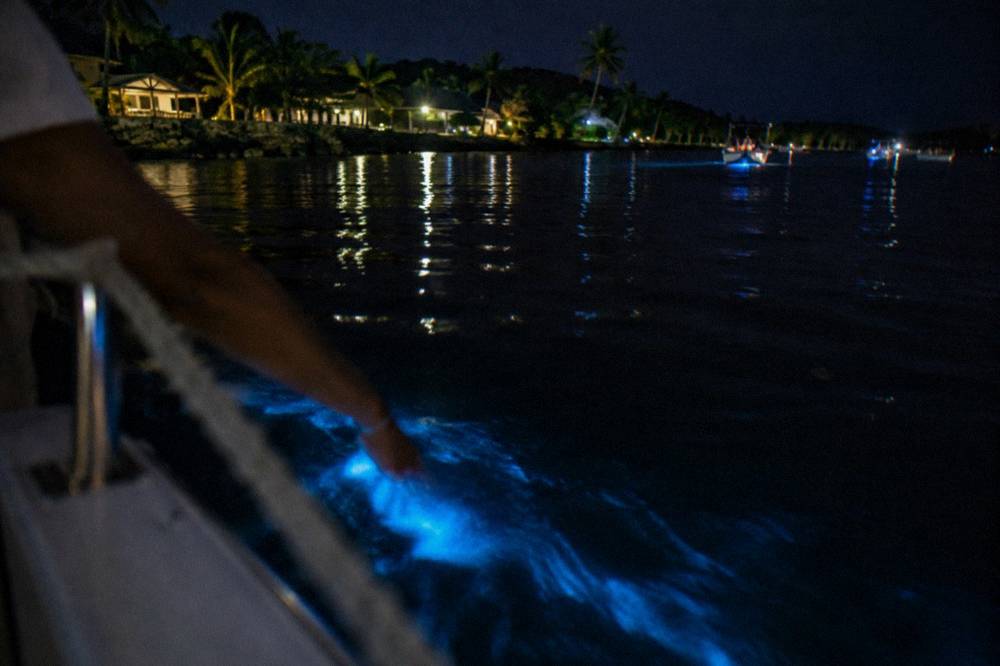
Dinoflagellates are a large group of plankton, and most of them do not glow at all. Pyrodinium bahamense is one of the species that does, and it is the same genus behind several bioluminescent bays in the wider Caribbean. What singles out the Jamaican population is less the organism than the container: an estuary where freshwater from the Martha Brae River meets Caribbean saltwater in a shallow, warm, nutrient-rich basin that suits the species unusually well. The genus needs relatively high salinity and warm temperatures to thrive, and the lagoon supplies both, along with the nutrients carried down from the river's watershed.
The cells also behave on a daily rhythm. Multiple tour descriptions are consistent on this point: the organisms recharge through daylight hours and give stronger displays after sunny days. That is not folklore, it tracks how the chemistry is restocked in the cell between flashes. It also explains a piece of practical advice that recurs across planning guides, including the site's own best-time-to-go guide: a calm, clear evening following a bright day is the condition tour operators themselves prefer, while a night after heavy rain often underdelivers.
If you want to see the reaction up close, the standard nightly boat trips from the marina are the direct route, and most visitors reach them through a packaged tour with transport. Two Montego Bay hotel-pickup options are a good place to start:
The featured listing, the Mesmerizing Luminous Lagoon (Glistening Waters) Night Tour, is the most reviewed of the lot, at 4.5 from 101 reviews, from $100 per person with hotel pickup and drop-off from Montego Bay hotels, and free cancellation listed. For readers coming from the east, the Luminous lagoon Dark Night Tour from Ocho Rios and Runaway Bay Hotels runs from $79 per person, 4.5 from 75 reviews, with the entrance ticket included.
Why Does The Lagoon Hold So Many Dinoflagellates?
The Luminous Lagoon sits where the Martha Brae River meets the Caribbean Sea, and that meeting point is the whole story. Fresh river water and salt seawater mix into a brackish, nutrient-rich zone that Pyrodinium bahamense thrives in. The basin is shallow, roughly 3 to 8 feet deep by the operator's own account, warm, and semi-enclosed, so the population stays concentrated instead of being flushed out to sea.
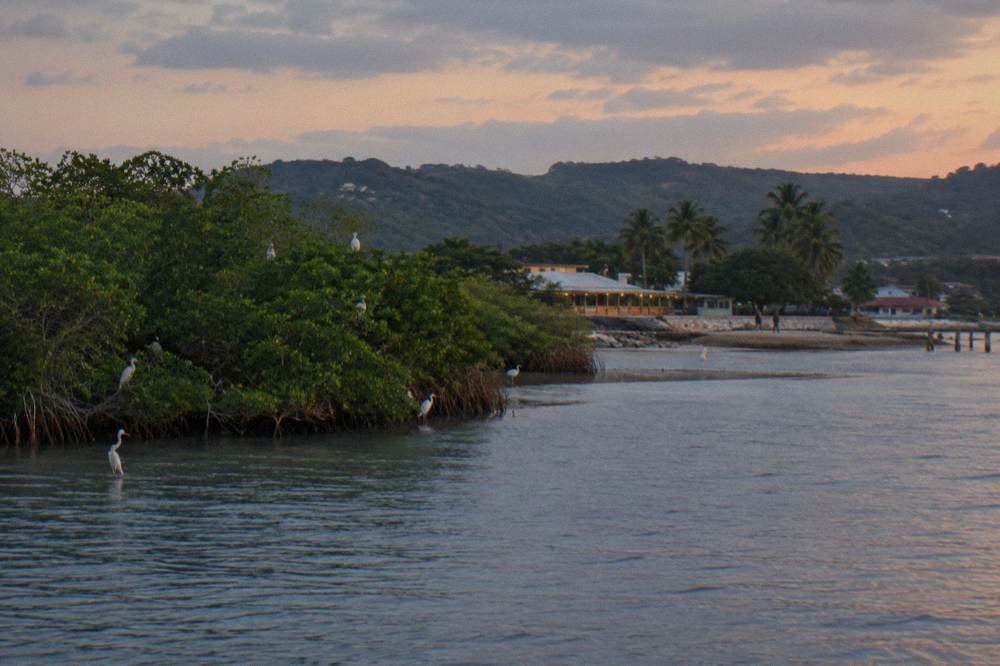
The lagoon runs along the marshland from the fishing community of Rock to the town of Falmouth in Trelawny. The Martha Brae River, the same river floated by bamboo raft a few miles upstream, drains a green, agricultural watershed and delivers a steady supply of minerals and organic material into the estuary. Where that freshwater meets and mixes with seawater, salinity lands in the range the species prefers, and the nutrients keep the population fed. Mangroves along the margins add to the mix. The operator's scientific page and the estuary's basic geography both support the same conclusion: the glow is a river-and-sea product, not an open-coast one.
Shallow water helps twice over. A cell flashing in three feet of water is simply closer to your eyes than one flashing in thirty, and a shallow, semi-enclosed basin holds its plankton in place rather than exchanging it with the open sea. The operator describes the depth as 3 to 8 feet, or more, and a tourist-board-linked site gives a similar range of about 3 to 4 feet with 8 at the deepest. That shallow warmth is also why swimming works so well here, a point the site covers in detail in whether you can swim in the lagoon. This is one of a handful of bioluminescent bays where the water is shallow and calm enough for tour boats to stop and let guests in.
The conditions that concentrate the population break down like this:
| Estuary condition | What it does for Pyrodinium bahamense |
|---|---|
| River meets sea at Falmouth | Creates the brackish salinity mix the species prefers |
| Martha Brae watershed nutrients | Keeps the population fed year-round |
| Shallow basin, about 3 to 8 feet | Concentrates cells close to the surface and the eye |
| Warm semi-enclosed water | Holds the population in place instead of flushing it out |
| Mangrove margins | Shelter the estuary and add to the nutrient mix |
The comparison with the better-known bays of Puerto Rico illustrates the point. Several of those are visited by kayak with no in-water contact allowed, while the Jamaican lagoon's defining feature, per multiple travel references, is that swimming is part of the standard tour. The site's full Puerto Rico comparison guide covers the differences without ranking the bays, since each is a distinct estuary with its own conditions.
Why Is The Glow Brighter On Dark Nights?
The organisms glow every night, but the glow is only as visible as the darkness around it. Moonlight is the single biggest factor: on a moonless or near-moonless night the blue flashes stand out against black water, while around a full moon the same flashes are washed out by ambient light. Operators and the marina itself say the glow is there nightly, and contrast is what changes.
This is physics rather than biology, and it is worth separating the two claims travelers often blur. The claim "the lagoon glows every night" is an operator statement about the organisms being present and active. The claim "you will see a spectacular display on any night you book" is not one anyone can honestly make, because on a bright moon night the water is lit from above and the eye cannot resolve the flash as sharply. Operators put it plainly: the brightest nights are those without moonlight. Reviews of the private listings echo it, with one guest noting to check the moon phase before booking and another reporting a near-new moon night.
The practical takeaway is to look at a moon calendar before you pick a date. The new moon window, and the two or three nights either side of it, gives the darkest skies. The site's dedicated moon phase guide walks through this in depth. Weather compounds it: warm, calm, clear evenings after sunny days are the preferred condition, since the cells recharge in daylight and calm water keeps the display crisp.
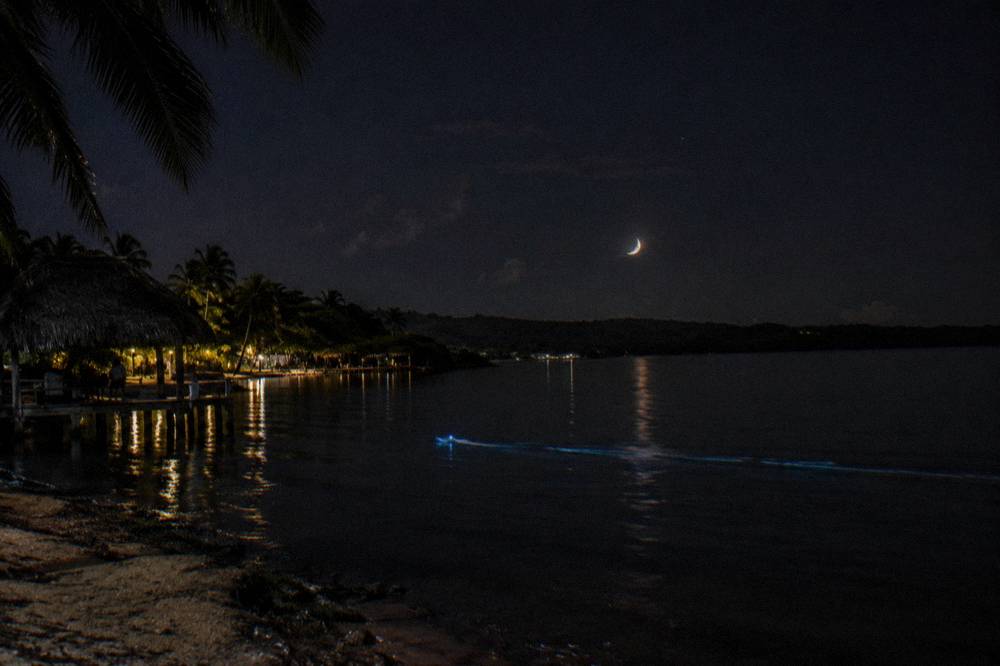

Because tour boats leave nightly from the marina, you can simply book the date that suits you and accept the contrast you get, or plan around the lunar calendar. One of the lower-cost shared options, the From Montego Bay: Luminous Lagoon Boat Tour with Transfer, runs from $61.57 per person with a swim listed and hotel transfer included, 3.8 from 16 reviews, which makes experimenting with a second dark-night visit less painful for the budget.
What Can Disturb Or Dim The Glow?
Heavy or recent rain is the main natural damper: it dilutes the dinoflagellate population with colder, fresher water and reduces both the density and the visibility of flashes. Bright moonlight washes out contrast, boat traffic and shore lighting add ambient light, and screens or phone lights on the boat itself cut what your eyes can resolve. None of these remove the organisms, they only change the show.
Rain is the factor guides mention most, and the mechanism is straightforward dilution. A burst of upstream rainfall sends a pulse of cooler, fresher water down the Martha Brae into the estuary, thinning the brackish mix the cells prefer and lowering the local density around the boat. The effect is temporary; the estuary re-mixes and the population recovers. Travel sources are consistent that heavy or recent rain dims the display, and equally consistent that overcast nights can still show well, since clouds block moonlight and help the contrast.
Human light is the factor you control. Phone screens and cabin lights on the boat reduce night-adapted vision, and operators ask that lights stay off on the water. Photography has its own limits: the operator says no flash and that a DSLR works best, and standard phone cameras are not promised to capture the glow at all, a reality the site's photos and video guide treats honestly rather than pretending otherwise.
| Factor | Effect on the glow | Can you plan around it |
|---|---|---|
| New moon window | Darkest skies, strongest contrast | Yes, check a moon calendar |
| Full moon | Same glow, washed-out contrast | Yes, avoid the week around it |
| Recent heavy rain | Dilution and colder water dim density | Partly, watch upstream weather |
| Calm clear night after sun | Well-rested cells, crisp display | Partly, weather dependent |
| Phone and boat lights | Cut night-adapted vision on the water | Yes, keep lights off |
The disturbance that makes the whole thing visible is, of course, movement, which is the one kind of disturbance you want. Nothing about the boat's wake harms the display; that is the point of the trip.
Can You See The Glow From Every Boat Tour?
Every lagoon tour on the same water triggers the same organisms, so the biology does not change between listings. What changes is the wrapper: departure point, group size, boat type, whether a swim is offered, and what else the evening includes. A one-hour listing is a short outing built around the boat ride, while longer listings add the drive from Montego Bay, Ocho Rios, Runaway Bay or Negril.
Because the glow is a property of the water, not of a particular operator, choosing among the trips covered here is a logistics decision rather than a science decision. A reader staying in Montego Bay can take the featured Mesmerizing night tour, from $100 per person with hotel pickup from Montego Bay hotels listed, or the Jamaica: Bioluminescent Lagoon Boat Cruise with Transfers, from $69 per person with round-trip Montego Bay area transfers and a swim listed, rated 3.9 from 89 reviews. Readers based east of Falmouth have the Ocho Rios and Runaway Bay departures, and readers who want their own vehicle can look at the private options. If you're still wondering whether the glow is real before you book, the science behind Jamaica's glowing lagoon explains exactly what causes it and where to look.
| Listing | Departs | From (per person) | Rating and reviews | Swim listed |
|---|---|---|---|---|
| Mesmerizing Luminous Lagoon (Glistening Waters) Night Tour | Montego Bay hotels | $100 | 4.5 from 101 reviews | Not stated |
| Jamaica: Bioluminescent Lagoon Boat Cruise with Transfers | Montego Bay hotels | $69 | 3.9 from 89 reviews | Yes |
| Luminous lagoon Dark Night Tour | Ocho Rios and Runaway Bay hotels | $79 | 4.5 from 75 reviews | Not stated |
| Private Tour from Ocho Rios Runaway Bay | Ocho Rios and Runaway Bay hotels | $85 | 5 from 90 reviews | Not stated |
| From Montego Bay: Luminous Lagoon Boat Tour with Transfer | Montego Bay hotels | $61.57 | 3.8 from 16 reviews | Yes |
The private category is worth a sentence of science framing: nothing about a private tour makes the glow stronger, and on these listings the privacy is in the vehicle, since at least one private listing states the boat ride itself is shared. The best-reviewed private listing is the Private Tour from Ocho Rios Runaway Bay to the Luminous Lagoon, a full 5 from 90 reviews, from $85 per person for up to 15 guests with the entry fee and bottled water included. No tour can promise a bright night, and our look at whether the lagoon's glow is real explains what causes it and what you can expect to see.
Combination tours answer a different question: what to do with the daylight hours before the glow becomes visible. Since the lagoon only performs after sunset, a day-plus-night pairing is the natural full-day shape, and the most established is the Dunn's River Falls & Luminous Lagoon Guided Tour from Montego Bay, from $190 per person across 9 hours, 4 from 42 reviews, with stops at Discovery Bay, Dunn's River Falls, Scotchies in Drax Hall and the lagoon. The falls sit near Ocho Rios, reachable as a day trip from Falmouth, and the run of stops fills the hours that the biology cannot. Whichever daytime stops fill the hours, the science behind the glow explains what the blue flashes in the water actually are once the boat reaches the lagoon.
One group the science genuinely constrains is cruise passengers. Scheduled Falmouth calls usually end mid-afternoon, so a night boat is off the table for most call days; check your ship's all-aboard time. The site's Falmouth cruise excursion guide covers what a port day can honestly include. For everyone else, the planning pieces on what to wear and bring and the operator's own scientific information page round out the picture, and the Luminous Lagoon Jamaica Tour homepage compares every listing side by side.
Understanding the mechanism changes how you book: you pick a dark window, you accept the weather, you keep the lights off, and you let the movement of the boat do the rest.
Common Questions About Lagoon Bioluminescence
How Does Bioluminescence Work In The Luminous Lagoon?
A chemical reaction inside the dinoflagellate Pyrodinium bahamense oxidises luciferin and releases the energy as a flash of blue-green light, peaking around 476 nanometres. The flash is triggered by mechanical disturbance, such as a boat wake, a swimmer or rain hitting the surface. The cells were measured at densities as high as 200,000 per litre in a 1966 study.
What Organism Creates The Glow At Glistening Waters?
Pyrodinium bahamense, a single-celled dinoflagellate plankton. Each cell is invisible individually; the display comes from millions of cells flashing together in response to movement in the water.
Why Does The Lagoon Hold So Many Dinoflagellates?
The lagoon is an estuary where Martha Brae River freshwater mixes with Caribbean saltwater, creating warm, shallow, nutrient-rich brackish water the species thrives in. The semi-enclosed basin keeps the population concentrated rather than flushed out to sea.
Why Is The Glow Brighter On Dark Nights?
The organisms flash every night, but visibility depends on contrast. Around the new moon the sky is dark and the blue flashes stand out; around a full moon the same flashes are washed out. Operators state the glow is present nightly and that brightness varies with ambient light.
What Can Disturb Or Dim The Glow?
Heavy or recent rain dilutes the population with colder, fresher water; bright moonlight and shore or boat lighting cut contrast; and phone screens reduce night-adapted vision. None of these remove the organisms, and the effect of rain is temporary as the estuary re-mixes.
Can You See The Glow From Every Boat Tour?
Yes in the sense that every tour operates on the same water and triggers the same organisms. Listings differ in departure point, group size, swim option and extras, not in the biology. Choose by logistics and night darkness rather than by operator.