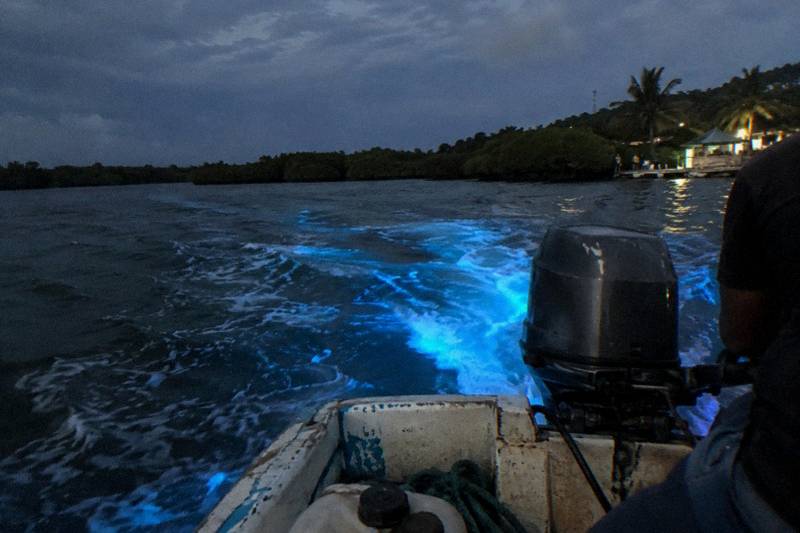
Luminous Lagoon And The Moon: New Moon Versus Full Moon Nights
The glow in the Luminous Lagoon is produced every night by dinoflagellates in the water at Falmouth, but how bright it looks depends mostly on how much moonlight is in the sky. Here is how the moon changes the experience, and how to plan around it.
Short answer
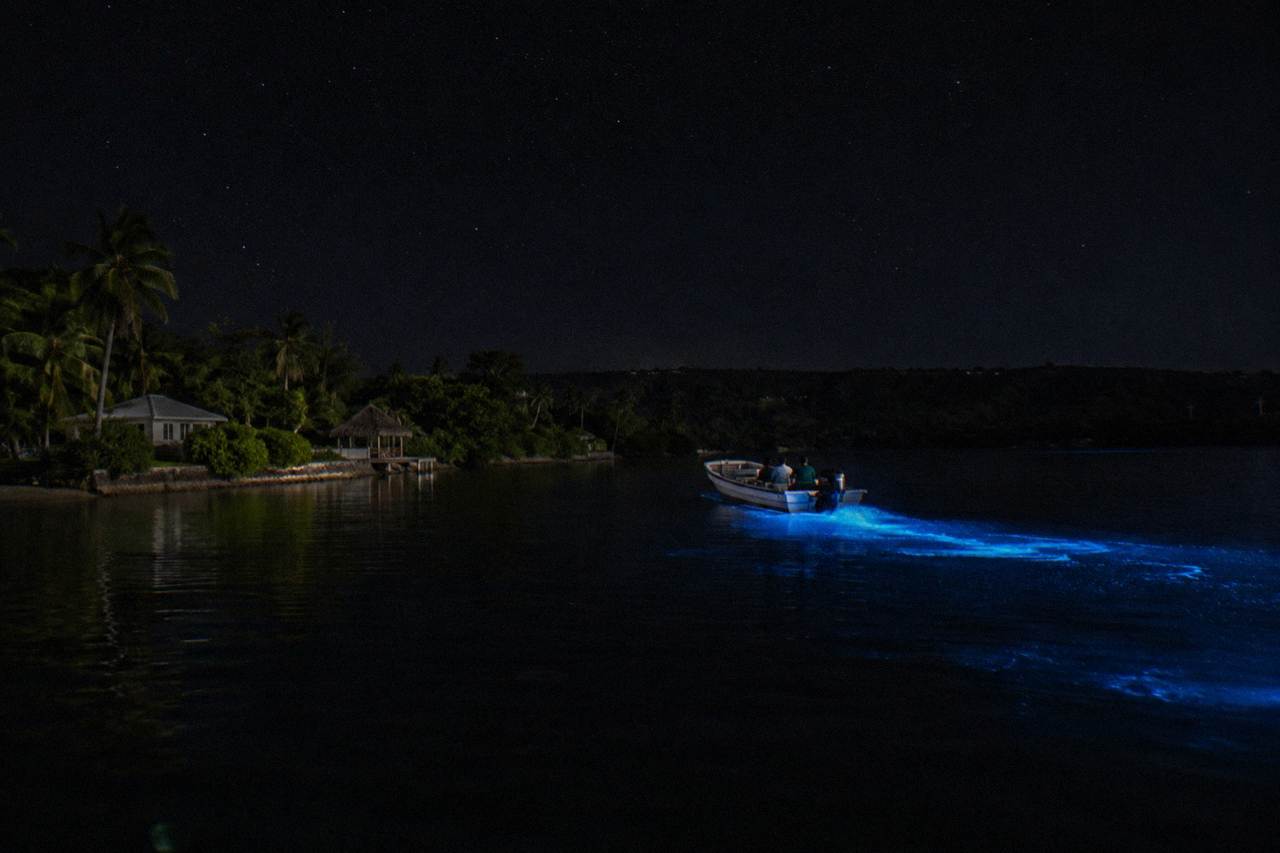
The organisms in the Luminous Lagoon produce light every night, but visibility is best around the new moon, within about three days either side of it, when the sky is darkest. Full moon nights still glow, yet the moonlight lowers the contrast and the effect looks weaker. Tours from Montego Bay start from $61.57 per person and run year-round.
The Luminous Lagoon at Falmouth glows because of a dinoflagellate called Pyrodinium bahamense, a microscopic organism that emits blue-green light when the water around it is disturbed, by a boat wake, a paddle, or a swimmer's arms. A 1966 Johns Hopkins study of the bay recorded densities as high as 200,000 cells per litre, and the population is still there, sustained by the mix of freshwater from the Martha Brae River and saltwater from the Caribbean Sea. The organisms do not switch off. What changes, night to night, is how much of their light you can actually see, and the single biggest variable is the moon.
That is why this guide exists. Most visitors book a lagoon night around a hotel stay or a cruise call and take whatever sky they get, which is fine, the glow is there. But travelers who plan around the lunar calendar consistently report stronger, more dramatic nights, and the difference between a new moon booking and a full moon booking is real enough that guest reviews on some listings tell others to check the moon phase before they go. This page walks through the mechanics, the phase-by-phase differences, and the practical booking decisions, including which of the tours covered here fit a dark-night plan best. The wider background on the site itself is in the Glistening Waters Jamaica guide, and the month-by-month picture is covered in the best time to go guide.
How Does Moonlight Change The Luminous Lagoon Glow?
Moonlight never dims the organisms themselves; it simply lowers the contrast between their glow and the water around it. The dinoflagellates emit the same blue-green light every night of the year, but on a moonless night it stands out sharply against black water, while under a bright full moon ambient light washes it out, so trails look fainter and shorter even though nothing biological has changed.
The operator's own science page and tour description make the point plainly: the lagoon lights up every night, and the variation is in what you perceive, not in what the organisms produce. Guest reviews on the listings echo it. One reviewer on a Montego Bay private tour notes to "check the moon phase" before booking, and another mentions the "moon was almost new" on a night that delivered. Those are individual accounts, not guarantees, but the pattern across operator guidance and guest reports is consistent.
The mechanism is simple once you picture it. Bioluminescence at 476 nanometers, in the blue-green range, is a relatively dim emission. Human eyes adjust to the brightest light source available, so on a moonlit night your night vision is partially suppressed and the water surface itself carries a silver sheen that competes with the glow. On a new moon, with no moonlight and ideally a clear sky away from shore lights, your eyes stay dark-adapted and every swirl of a hand or turn of a propeller reads as bright blue fire.
There is a second layer worth knowing. The organisms recharge on a circadian rhythm during daylight hours, so a sunny day followed by a dark night is the classic strong combination. Rain matters too: heavy or recent upstream rain can dilute the dinoflagellates and introduce cooler water, which dims the effect. So the strongest nights combine three things, darkness from the moon phase, calm clear weather, and warmth. You control only the first of those when you book, which is exactly why the moon is the planning variable worth using.
Which Moon Phase Gives The Brightest Luminous Lagoon Nights?
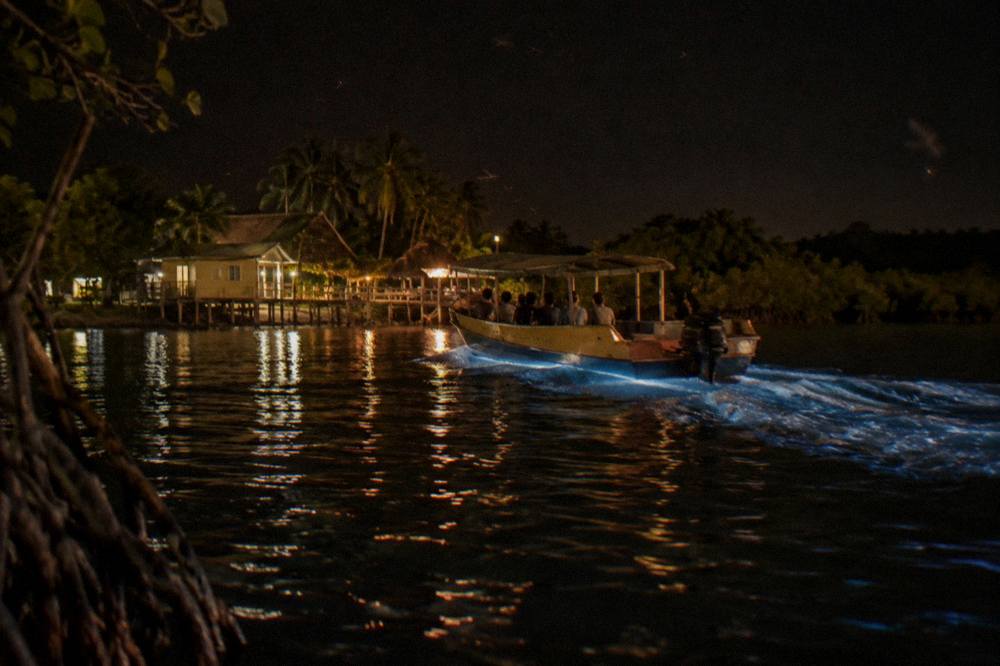
The new moon window, roughly three days either side of the new moon, gives the darkest skies and the strongest contrast for viewing the glow, according to multiple bioluminescence planning sources. A waxing or waning crescent is nearly as good. Quarter moons are a middle case, and the full moon is the weakest night for visibility, though the glow is still produced and movement in the water still creates visible trails. Tours run every night regardless of phase, weather permitting.
The phase-by-phase breakdown below pulls together operator guidance and published season guides. Treat it as a visibility guide, not a promise: no operator guarantees a glow strength, and natural factors like recent rainfall can override everything on any given night.
| Moon phase | Sky darkness | Expected visibility of the glow | Planning note |
|---|---|---|---|
| New moon (±3 days) | Darkest | Strongest contrast, brightest-looking trails | Book these dates first |
| Crescent (waxing or waning) | Very dark until moonrise or after moonset | Nearly as strong as new moon | Great value window; check moonrise and moonset times |
| Quarter moon | Partial moonlight for part of the night | Moderate; good before moonrise | Works if the boat departs before the moon climbs |
| Gibbous | Bright for most of the night | Noticeably washed out | Acceptable, not ideal |
| Full moon | Bright all night | Glow present but low contrast | Still worth going if dates are fixed; manage expectations |
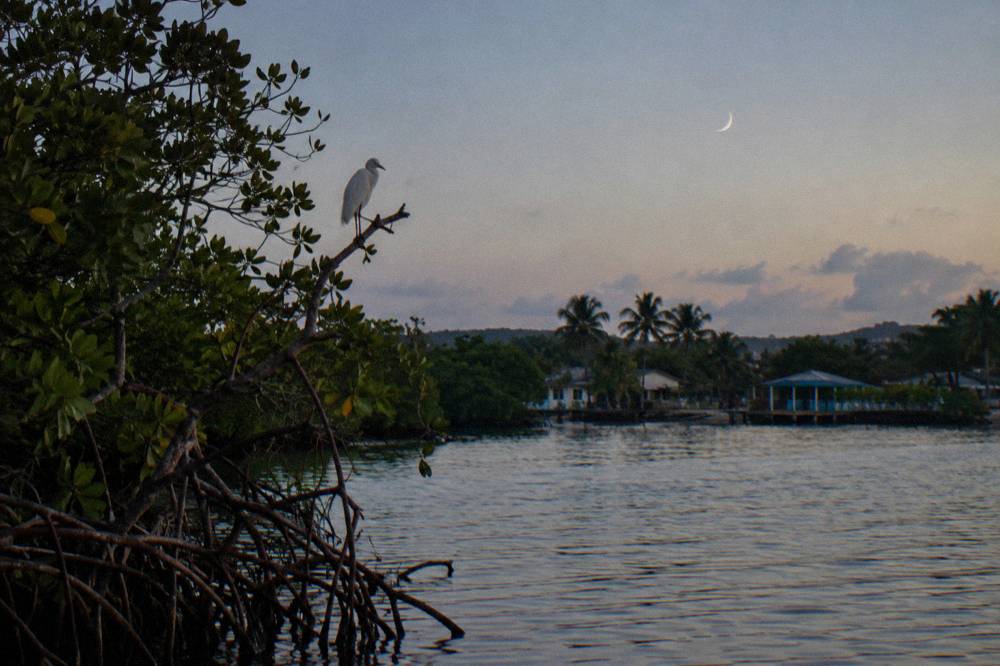
A detail many first-time visitors miss: the moon rises and sets at shifting times, so even a crescent or quarter moon can give you a fully dark window for part of the evening. A waning crescent rises in the hours before dawn, which means the entire evening after sunset is moonless. A waxing crescent sets fairly soon after sunset. If your travel dates land near a quarter moon, an early boat departure still catches dark water. Standard lagoon boats run about 35 to 45 minutes on the water with tours starting at sunset, per the operator's schedule, so departure timing interacts directly with moonrise.

If you are choosing between the tours covered here for a dark-night plan, the three below are Montego Bay departures at three price points, from $61.57 to $90 per person, and every one states free cancellation on its listing, which matters when you are gambling on a sky.
How Do You Plan A Trip Around The Moon At Glistening Waters?
Start with your travel window, locate the new moon date within or closest to it, and book the lagoon night matching that date instead of the first free evening. Then cross-check Falmouth moonrise and moonset times for your chosen night, reserve a listing with free cancellation, and confirm your departure point, Montego Bay, Falmouth, or Ocho Rios, before you pay.
The order of operations matters because most people do it backwards. They book hotels and flights, then look for a lagoon tour on a random evening. Planners do the reverse: the moon calendar comes first. If your Jamaica week contains a new moon or a strong crescent, that is your lagoon night. If your week is full moon only, go anyway, the glow is produced nightly and swimming is part of the standard operator tour, but set expectations toward "subtle trails" rather than "bright fire", and lean on the swim, because the glow around your own body reads brighter up close than the water at a distance.
Drive time is the other planning input. The marina at Rock, Falmouth sits roughly 30 minutes east of Montego Bay per the operator's directions page, with travel sites quoting 30 to 40 minutes from the Montego Bay airport to Falmouth. Ocho Rios to Falmouth is about an hour and Negril about 2 hours, so treat that one as approximate. Runaway Bay drive times differ by source, so check your hotel's distance against the listing.
| Departure area | Approximate drive to Falmouth | Listing example | From price |
|---|---|---|---|
| Montego Bay hotels | Roughly 30 to 40 minutes | Mesmerizing Luminous Lagoon Night Tour | From $100 per person |
| Sangster airport area | Roughly 30 to 40 minutes | Boat Cruise with Transfers | From $69 per person |
| Ocho Rios and Runaway Bay hotels | Roughly an hour | Dark Night Tour from Ocho Rios and Runaway Bay | From $79 per person |
| Negril hotels | Roughly 2 hours | Glistening Waters Tour From Negril Hotels/Airbnb | From $180 per person |
| Falmouth itself | Short local ride | Tour from Falmouth | From $95 per person |
The two listings most built for a moon-aware plan are worth naming. The featured listing here, the Mesmerizing Luminous Lagoon (Glistening Waters) Night Tour from Montego Bay, runs 1 hour total, from $100 per person, rated 4.5 from 101 reviews, with hotel pickup and drop-off from Montego Bay hotels included and free cancellation stated. You can check availability once your dates are set, and the free cancellation line gives you room to shift nights if the weather turns. The Montego Bay departures guide compares the full set of twelve listings from that area.
Does The Moon Change Swimming And Boat Tours On The Lagoon?
No, the moon changes the spectacle, not the activity itself: swimming is offered regardless of moon phase, the water depth, reported by the operator at about 3 to 8 feet or more, stays the same, life jackets are available on the boats, and the standard tour includes the swim stop. Dark nights let the glow trace every limb movement, while bright nights concentrate it close to the body and fade with distance.
The swim is arguably the most moon-sensitive part of the night. From the boat, a washed-out glow is a disappointment; in the water, even a modest glow surrounds you, because you are the disturbance creating it. Guests who swim on full moon nights still report visible trails around their arms and legs. The rule of thumb from the operator and from guest accounts: view from the boat on bright nights, swim on dark ones, and swim either way if the water is calm, because up-close light beats distant light. The rest of the planning pages sit on Luminous Lagoon Jamaica Tour.
Practical notes that apply on any night, per the operator and visitor guides: bring swimwear and a towel, since swimming is part of the standard tour; the marina has changing rooms; dark swimsuits are advised because the brackish water can stain lighter colors; and water shoes or rubber-soled waterproof shoes help on the soft lagoon floor. Photography is its own challenge. The operator says no flash and that a DSLR works best, and phone cameras are not promised to capture the glow, a point worth accepting in advance so you spend the night looking at the water instead of at a screen. Phone screens and lights need to stay off on the lagoon anyway, since ambient light reduces visibility for everyone. For a closer look at what cameras actually capture, our lagoon photo and video guide sets realistic expectations before you go.
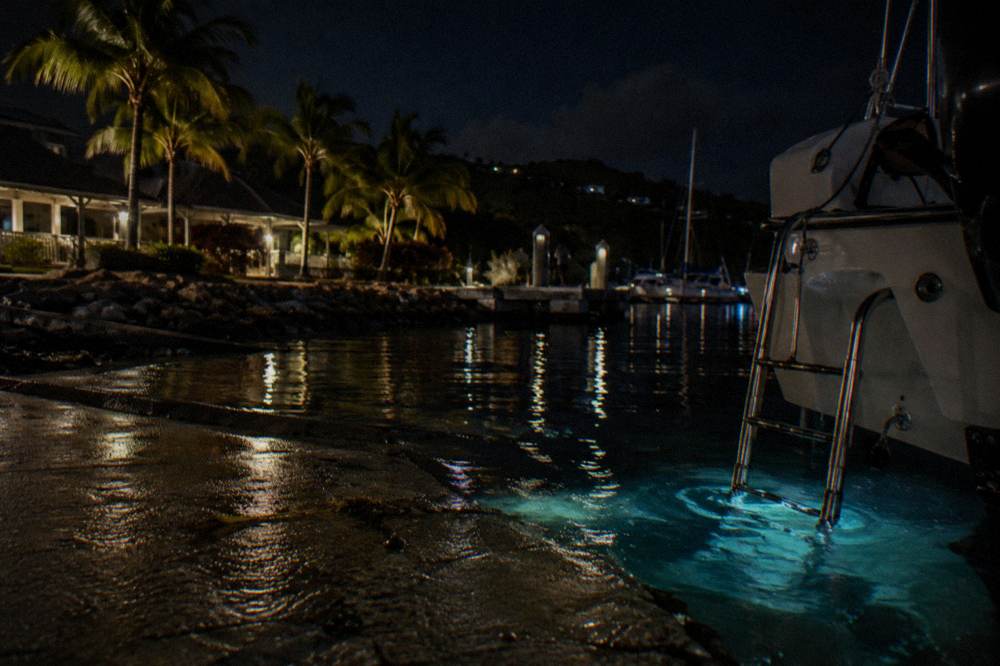
If swimming is the priority, pick a listing whose line actually states it. Among the Montego Bay options, the Jamaica: Bioluminescent Lagoon Boat Cruise with Transfers lists swim, runs 1.5 to 2 hours, from $69 per person, rated 3.9 from 89 reviews, with round-trip transfers from the Montego Bay area included and free cancellation stated.
What Besides The Moon Affects The Glow At Falmouth?
Rain, cloud cover, recent weather, and the season all move the needle alongside moonlight at Falmouth. Heavy or recent upstream rain dilutes the dinoflagellates and cools the water, dimming the effect, while the dry season from December to April is often described as the brightest stretch, and tours run year-round through hurricane season, June 1 to November 30, with a statistical peak from August to October.
The moon is the factor you can plan around, but it is not the strongest factor on every night. Operators and guest reports point to a hierarchy: ambient darkness first, then recent rainfall, then general calm and warmth. The organisms recharge through daylight on a circadian rhythm, so long sunny days feed stronger nighttime displays. Overcast skies cut moonlight, which helps on bright phases, but heavy cloud can also come with rain and wind, which hurts. A thin layer of cloud on a full moon night is, oddly, one of the better compromise skies you can get.
Seasonality stacks with phase. The dry season, December to April, combines fewer rain disruptions with the tour calendar's steadiest operations, and it is often described as yielding the brightest conditions. The rainy months from May to November still run tours unless there is a storm, and guests report sparkle on overcast nights, but the odds of a rain-diluted outing are higher. If your travel dates are fixed inside hurricane season, a new moon booking still beats a full moon booking, just book with the free-cancellation listings covered here and watch the forecast.
| Factor | Effect on the glow | Can you plan around it? |
|---|---|---|
| Moon phase | Sets ambient light and contrast | Yes, book the dark window |
| Recent heavy rain | Dilutes organisms, cools water | Partly, watch forecast and rebook |
| Sunny days before | Recharge via daylight rhythm | Not directly, but dry season helps |
| Overcast sky | Cuts moonlight, can help or hurt | Watch same-day forecast |
| Wind and chop | Scatters trails, rougher boat ride | Same-day call |
| Season | Dry season often brightest, tours year-round | Yes, choose travel month |
One thing no listing or operator offers is a glow guarantee, and none should. No published operator policy promises refunds specifically for a weak glow, and the standard free-cancellation terms on the listings covered here apply to schedule changes, typically with notice. The honest framing: book the darkest window you can, swim if conditions allow, and treat anything above subtle trails as a good night.
How Do You Pick A Luminous Lagoon Tour For A Dark Night?
Match your departure point and group-size tolerance to a dark-window departure listed with free cancellation. From Montego Bay, the featured night tour runs from $100 per person with hotel pickup listed, while the Dark Night Tour from Ocho Rios and Runaway Bay runs from $79 per person, rated 4.5 from 75 reviews, for up to 15 guests, and private options from Ocho Rios start from $85 per person.
The comparison comes down to departure area, price, and group size, since the boat experience at the marina is broadly the same underneath. The table below compares the listings most suited to a planned dark-night trip across the three main departure areas.
| Listing | Departs | From price | Duration | Rating and reviews | Group cap |
|---|---|---|---|---|---|
| Mesmerizing Luminous Lagoon Night Tour | Montego Bay hotels | $100 per person | 1 hour | 4.5 from 101 reviews | Up to 25 guests |
| Bioluminescent Lagoon Boat Cruise with Transfers | Montego Bay hotels | $69 per person | 1.5 to 2 hours | 3.9 from 89 reviews | Not stated |
| Luminous Lagoon Dark Night Tour | Ocho Rios and Runaway Bay hotels | $79 per person | 3 hours | 4.5 from 75 reviews | Up to 15 guests |
| Private Tour from Ocho Rios Runaway Bay | Ocho Rios and Runaway Bay hotels | $85 per person | 2 hours | 5 from 90 reviews | Up to 15 guests |
| Bioluminescent Lagoon Tour: Night Swimming and Liming | Montego Bay | $80 per person | 1 hour 30 minutes | 4.5 from 63 reviews | Up to 60 guests |
| From Montego Bay: Luminous Lagoon Boat Tour with Transfer | Montego Bay hotels | $61.57 per person | 3 hours | 3.8 from 16 reviews | Not stated |
Durations are each listing's own total, which can include the drive, so a 1 hour listing is not a 1 hour boat ride. Note the differences that matter on a dark night specifically. The Dark Night Tour from Ocho Rios and Runaway Bay, 3 hours total, up to 15 guests, hotel pickup and drop-off included, entrance fee in the inclusions, suits a small-group dark-window plan from the east. The Private Tour from Ocho Rios Runaway Bay, rated 5 from 90 reviews, from $85 per person with entry fee and bottled water included, suits families who want the vehicle to themselves. Names look alike across these listings, but they are different products with different operators, inclusions, and caps, so read the specific listing before booking rather than the title alone.
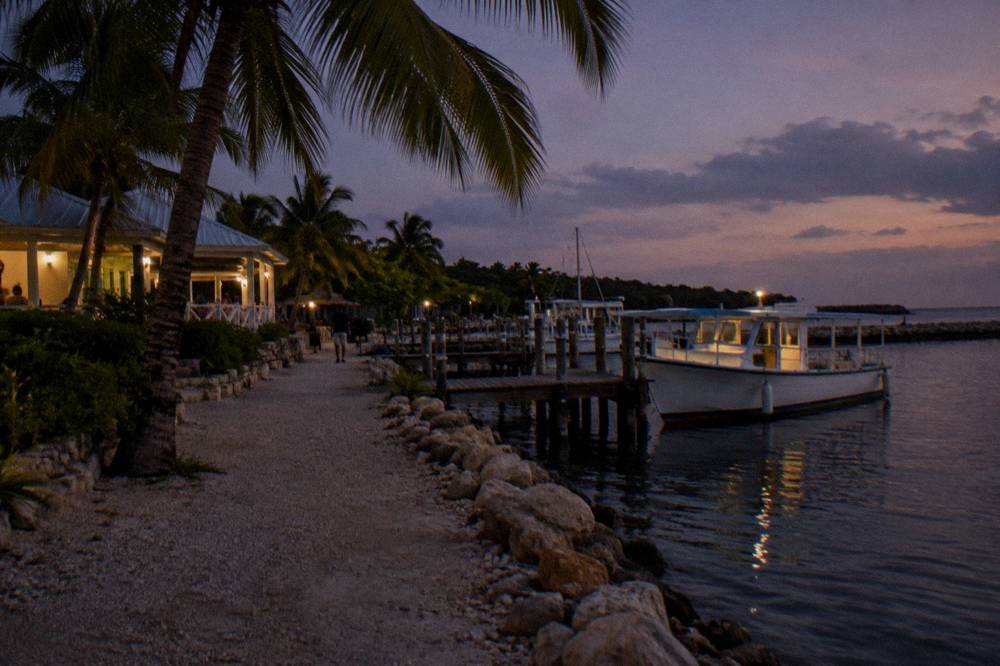
Cruise passengers should note the honest limit here: scheduled Falmouth calls mostly end mid-afternoon, check your ship's all-aboard time, so a night lagoon boat does not normally fit a port day. That planning problem, and the day-lit alternatives, are covered in the Falmouth cruise excursion guide. Hotel-based travelers have no such constraint, which is why the moon-phase plan works best for stays of four nights or more: more nights in country means more chances one of them is dark. The same logic extends to combining the lagoon with a day activity, and the Dunn's River Falls pairing guide covers the 9 hour combo from Montego Bay, from $190 per person, rated 4 from 42 reviews.
Common Questions About The Moon And The Luminous Lagoon
Does The Luminous Lagoon Glow On A Full Moon?
Yes, the organisms produce light every night of the year. What changes is visibility: moonlight lowers the contrast, so trails look fainter. Guests on full moon nights still report glow close to the boat and around swimmers, just less dramatic than on dark nights.
How Many Days Around The New Moon Are Best?
Planning sources point to roughly three days either side of the new moon as the darkest, strongest-contrast window. Crescent phases just outside that window are nearly as good, especially a waning crescent, which rises before dawn and leaves the whole evening moonless.
Can I Rebook My Lagoon Tour If The Weather Turns?
Every listing covered on this page states free cancellation, so a schedule change is possible per that listing's terms. No operator policy found guarantees a refund specifically for a weak glow, so book the darkest window you can and treat the phase as your best lever.
Is Swimming Allowed On Every Tour?
Swimming is part of the standard operator tour, but not every transfer listing states it. Check the specific listing: among the Montego Bay options, the Bioluminescent Lagoon Boat Cruise with Transfers lists swim, and the Explore Montego Bay tour lists swim as well. Bring swimwear and a towel.
Do Phones Capture The Glow?
Not reliably. The operator advises no flash and says a DSLR works best, and phone cameras are not promised to capture the glow at all. Plan to experience it with your eyes, and keep screens off on the boat, since ambient light reduces visibility for everyone.