How Many Bioluminescent Bays Are There In The World?
Counts vary by definition, but a handful of permanent bioluminescent bays exist worldwide and Jamaica's Luminous Lagoon at Falmouth is one of them. Here is what the science says and how to see it.
Ask how many bioluminescent bays exist and the honest answer is frustrating and useful at once: it depends entirely on what you count. Published counts do not match, some lists quietly grow every year, and the disagreement is not dishonesty, it is definition. A bay where millions of glowing microorganisms live permanently, night after night, year after year, is a far rarer thing than a beach where the water occasionally sparkles after a bloom.
Jamaica's Luminous Lagoon at Falmouth belongs in that small club. The light comes from the dinoflagellate Pyrodinium bahamense, recorded at densities as high as 200,000 cells per litre in a 1966 study of the bay published in the Journal of Marine Research. That is the core of its case: the organisms are not visitors, they live there, sustained by the steady mixing of Martha Brae River freshwater and Caribbean seawater where the lagoon meets the sea.
For travellers the practical question sits behind the trivia. If a persistent glowing bay is rare, the trip to see one deserves a little planning, and not every glowing-water claim on a booking page points to the real thing. This article walks through the count, why the numbers disagree, what makes Jamaica's lagoon distinctive, and which night boat trips actually put you on the water.
No single official count exists, because there is no agreed definition of a bioluminescent bay. Travel sources give different counts, and the honest summary is that Jamaica's Luminous Lagoon is one of a handful of such places on Earth, distinguished by the fact that you can swim in it on a scheduled nightly boat tour.
The core of the argument is permanence. Bioluminescence itself is common in the ocean, produced by everything from plankton to deep sea fish. What is rare is a shallow, sheltered body of water where dinoflagellates concentrate in enormous numbers and stay there, glowing every night of the year, weather and seasons permitting. That combination, a river mouth feeding nutrients into a warm, brackish, protected lagoon, is geographically unusual. Jamaica has one of the clearest cases.
The disagreement between sources comes down to thresholds. Count only bays with documented, year-round, high-density populations and the list is very short. Loosen the definition to include seasonal displays, kayak-only estuaries, or bays whose glow has faded and returned, and the list grows. The site you are reading takes no side in the arithmetic, because the arithmetic is not the point.
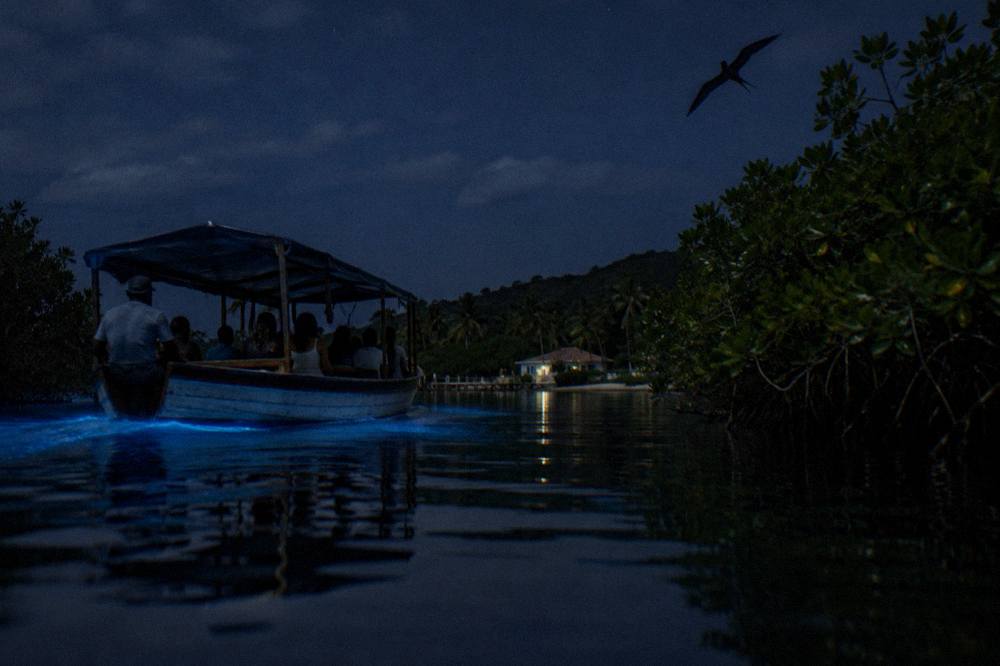
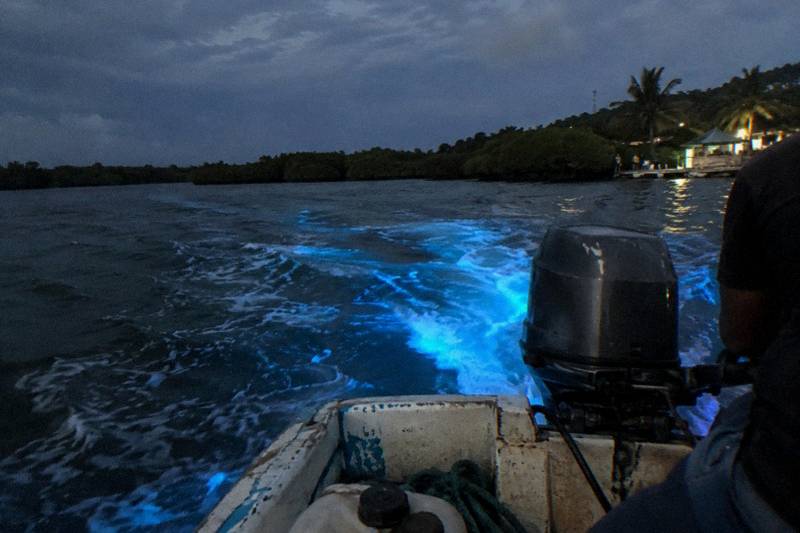
What is not in dispute is Jamaica's standing. The Luminous Lagoon Jamaica Tour covers the Falmouth site because it has a documented resident population and nightly tours. The operator, Glistening Waters Marina, Hotel and Attraction, runs boats from the dock at Rock, Falmouth, in Trelawny, roughly 30 minutes east of Montego Bay per the marina's own directions page. Tours depart nightly starting at sunset. Guests report that the glow appears in the boat's wake, around swimmers' limbs, and wherever hands disturb the water, exactly the mechanical trigger the organisms respond to.
If the count question is what brought you here, the booking question is probably next. These three Montego Bay lagoon night tours are a good place to start comparing:
The most reviewed lagoon trip covered here, the Mesmerizing Luminous Lagoon Night Tour from Montego Bay hotels, runs from $100 per person for a one-hour outing, holds a 4.5 rating from 101 reviews, and lists free cancellation and hotel pickup and drop-off. For a broader comparison across every departure area, see the companion guide to Luminous Lagoon tours compared.
Where Are The Other Bioluminescent Bays?
Puerto Rico's bays, including Mosquito Bay on Vieques and Laguna Grande in Fajardo, appear on most lists alongside Jamaica's Luminous Lagoon, and the rest of any list varies by source. Rather than repeat a shaky count, treat Jamaica's lagoon as one of a handful of permanent bioluminescent bays, and note that it is the one you can swim in on a nightly scheduled tour.
Puerto Rico is the other name that always appears. Its best known bay allows only kayaks, with no in-water contact, a conservation rule that shapes the whole experience there. Jamaica's lagoon takes the opposite approach: swimming is part of the standard operator tour, in water the operator describes as about 3 to 8 feet deep. For a proper head-to-head, including how the experiences differ on the water, read the site's detailed guide on Luminous Lagoon versus Puerto Rico's bioluminescent bays.
Why do the lists wobble? Because candidate sites rise and fall with their organisms. A bay's glow depends on salinity, temperature, nutrient flow, and rainfall, and populations can thin in wet seasons or after storms. A place that glowed strongly a decade ago may glow weakly now, and a source that last checked years ago keeps it on the list. This is also why no responsible writer promises a sighting on any given night: strength varies with the moon, rain, and the character of the season.
The distinguishing facts about Jamaica's entry are stable and worth knowing before you book:
| Fact | Detail |
|---|---|
| Organism | Pyrodinium bahamense dinoflagellates, blue-green light peaking near 476 nm |
| Recorded density | As high as 200,000 cells per litre in a 1966 study |
| Location | Marshland from the fishing community of Rock to Falmouth, Trelawny, where the Martha Brae River meets the sea |
| Depth | Operator states about 3 to 8 feet |
| Tour length | About 35 to 45 minutes on the water, departing at sunset |
| Swimming | Offered on the standard tour; bring swimwear and a towel |
The estuary is the engine. Freshwater from the Martha Brae River meets saltwater from the Caribbean Sea across the lagoon, and the brackish mixing zone is what the dinoflagellates need to hold their numbers. The organisms recharge during daylight hours on a circadian rhythm, which is why guides prefer clear evenings after sunny days: the population has had a full day of light and the display tends to be stronger. The operator's own scientific page walks through this in detail at Glistening Waters scientific information.
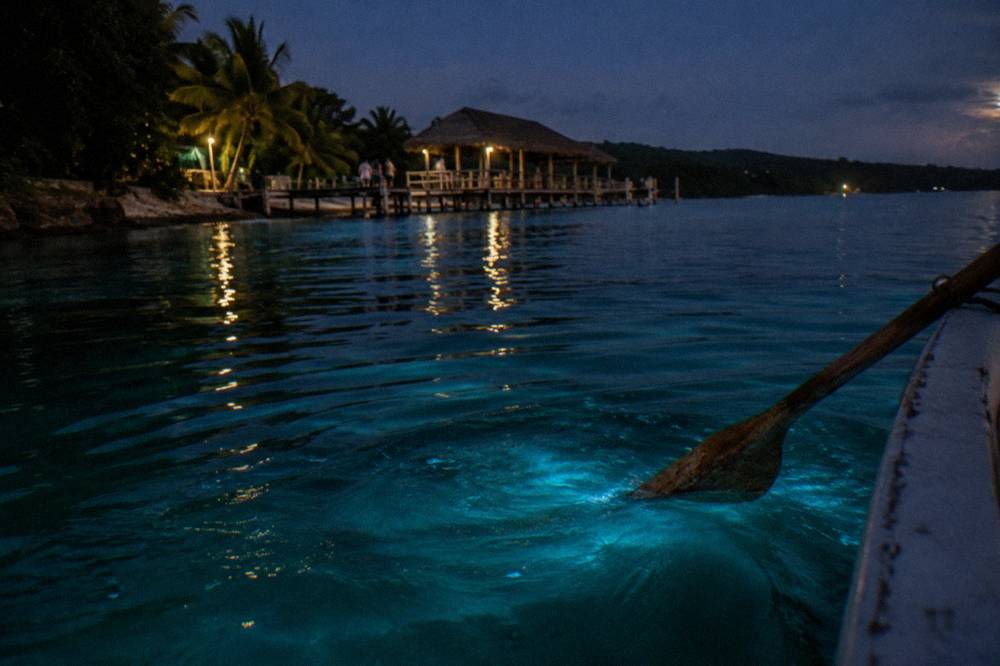
One caution for list-chasers: plenty of coastlines produce occasional bioluminescent flashes, and social media footage from a one-off bloom does not make a permanent bay. If seeing the phenomenon on a scheduled, reliable basis matters to you, book a bay with a nightly commercial tour operation and a documented organism population. Falmouth has both, with boats running seven nights a week, weather permitting, per the operator's tour page.
What Makes The Luminous Lagoon Different From Every Other Glow?
Jamaica's lagoon stands out for swimmability, accessibility, and consistency: the standard tour lets guests enter the shallow warm water among the glowing organisms, the site sits between Montego Bay and Falmouth with nightly departures, and the population is resident year-round rather than seasonal. Few glowing bays combine all three.
The swim is the headline. On the standard operator tour, the boat stops and guests who want to can slip into the water, where the operator reports depths of about 3 to 8 feet. Movement is the trigger, so every stroke leaves a trail of blue-green light. Not every listed tour includes a swim, so check the listing before booking if being in the water rather than above it is the goal. Among the options covered here, the Jamaica: Bioluminescent Lagoon Boat Cruise with Transfers lists swimming explicitly, runs 1.5 to 2 hours from $69 per person, and holds a 3.9 rating from 89 reviews, with round-trip transfers from the Montego Bay area included.
Accessibility is the second difference. Some glowing bays require a kayak paddle through mangroves at night to reach; Falmouth's lagoon is a dock departure. Boats hold up to about 30 guests each, per the operator's tour description, from a fleet of four boats. The marina sits on the A1 main highway at Rock, a short drive from central Falmouth and roughly 30 minutes east of Montego Bay per the marina's directions page, which makes it workable as an evening add-on to a Montego Bay, Falmouth, or even Ocho Rios stay.
Consistency is the third. Because the dinoflagellate population is resident rather than blooming and fading, tours run every night of the year, weather permitting. The strength of the display still varies, and no honest writer will promise a blinding glow on a full-moon evening, but the organisms themselves do not take the season off. Guests report that even on quieter nights the wake and the swimmers' trails still light up.
When Is The Glow Brightest At The Lagoon?
Moon phase matters more than any other factor: the glow is produced every night, but it is easiest to see on dark, moonless evenings, especially in the December to April dry season after calm, sunny days. Heavy or recent rain can dim the display by diluting and cooling the water.
The glow does not switch off on bright nights; the contrast does. A full moon lifts the ambient light level, and the blue-green emission, which peaks near 476 nanometres, competes with moonlight reflecting off the surface. Around the new moon, and for a few nights either side, the water is the brightest thing on the horizon and the same display reads dramatically stronger. Reviewers on lagoon listings make the same point, with one noting to check the moon phase before booking.
Rain works differently. Upstream rainfall sends cooler, fresher water into the estuary and can dilute the dinoflagellate concentration near the surface, thinning the glow. The lagoon sits in the Atlantic hurricane season from June through November, with a statistical peak from August to October, and tours pause for storms, but the rainy season does not shut the experience down. Overcast nights are often fine; the rain that matters is what has recently fallen upstream.
A simple planning frame:
| Condition | Effect on the glow | Planning takeaway |
|---|---|---|
| New moon, plus or minus 3 nights | Darkest skies, strongest contrast | Book these dates first |
| Full moon | Glow present but harder to see | Manage expectations or pick another night |
| Calm evening after a sunny day | Population recharged during daylight | Often a strong display |
| Recent heavy upstream rain | Dilution and cooler water can dim it | Consider a later evening in your stay |
| Dry season, December to April | Often the brightest stretch per seasonal reporting | Popular; book ahead |
If your dates are fixed by a flight, do not despair over a bright moon. The lagoon glows every night in the sense that the organisms are always there and always light when disturbed; what changes is how much ambient light you are fighting. Guests on full-moon nights still report glowing wakes and lit swimming trails, just less dramatic against a silvered surface.
How Do You Actually Book A Trip To A Glowing Bay?
For Jamaica's lagoon, you book a night boat tour with transport, most commonly from Montego Bay hotels, Falmouth, or Ocho Rios and Runaway Bay, with prices on the listings covered here starting at $55 per person and running past $100 for longer, private and combo options. All of the featured listings state free cancellation, so dates can be adjusted if the moon or weather argues for another night.
The most reviewed option is the Mesmerizing Luminous Lagoon Night Tour, from $100 per person, 4.5 from 101 reviews, one hour, with hotel pickup and drop-off from Montego Bay hotels included and a stated cap of up to 25 guests. A close alternative from the same departure area is the Explore Montego Bay to Luminous Lagoon Night Tour, from $90 per person, 4.5 from 78 reviews, one hour, with pickup from Montego Bay hotels and a swim in the glowing lagoon listed among its features. Both listings state free cancellation, which matters when you are chasing a dark sky rather than a fixed date.
From the east, the Luminous lagoon Dark Night Tour from Ocho Rios and Runaway Bay Hotels runs 3 hours from $79 per person, holds a 4.5 rating from 75 reviews, includes hotel pickup and drop-off and the entrance ticket, and caps the group at up to 15 guests. Travelers staying in Ocho Rios can also consider the Private Tour from Ocho Rios Runaway Bay to the Luminous Lagoon, a private option from $85 per person with a 5.0 rating from 90 reviews, bottled water listed, entry fee included, and up to 15 guests.
Longer days are also on the table. The Dunn's River Falls and Luminous Lagoon Guided Tour from Montego Bay pairs a daytime climb at the falls with the evening boat, 9 hours from $190 per person, 4 from 42 reviews. An Evening on the Lagoon combines Martha Brae rafting, the lagoon and a Falmouth highlight tour over 6 hours from $280 per person, with lunch included. If your interest in the bay count extends to the rest of Jamaica's coast, the Falmouth Jamaica guide covers what else fills a day there.
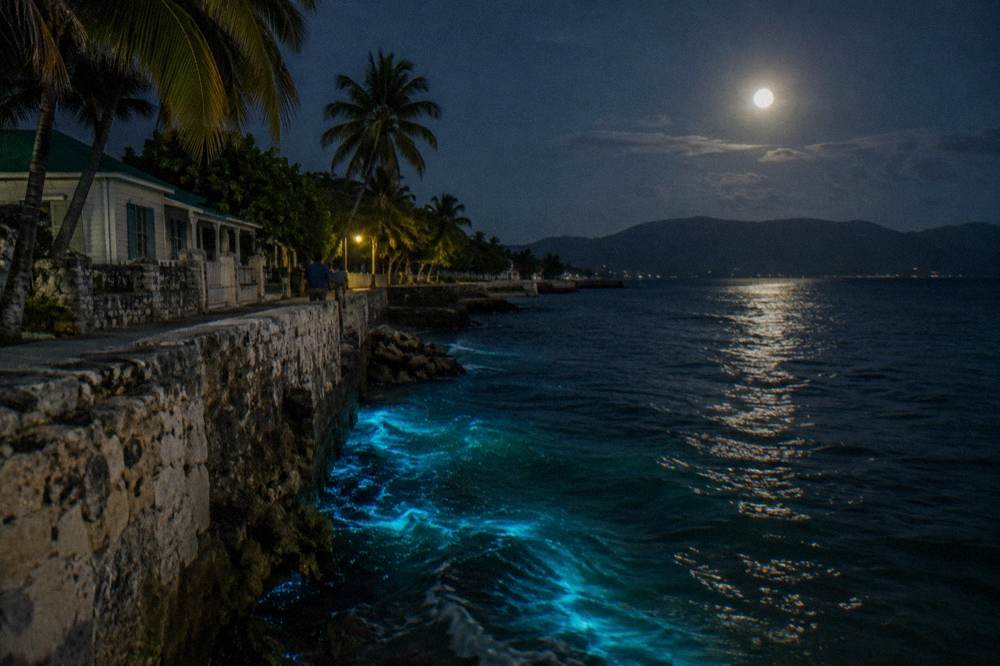
Two booking habits serve bioluminescence chasers well. First, check the moon phase for your travel window before locking a night, exactly as experienced reviewers suggest. Second, keep the free-cancellation listing and a backup evening in reserve, so a storm or a washed-out night does not end the quest. The glow does not take reservations, but a flexible one does the next best thing. For deeper planning, the best time to go guide works through moon and season in full.
Common Questions About Bioluminescent Bays
How Many Bioluminescent Bays Are There In The World?
There is no agreed count. Published counts differ, and the number shifts with the definition used. The safe, accurate statement is that Jamaica's Luminous Lagoon is one of a handful of bioluminescent bays on Earth, with a documented resident population of dinoflagellates recorded as high as 200,000 cells per litre in a 1966 study.
Where Are The Other Bioluminescent Bays?
Puerto Rico's bays, including Mosquito Bay on Vieques and Laguna Grande in Fajardo, appear on most lists alongside Jamaica's Luminous Lagoon at Falmouth, and the rest of any list varies by source. Rather than chase a shaky count, focus on the bay you can actually visit on a scheduled nightly tour: Falmouth's lagoon runs boats at sunset seven nights a week, weather permitting, and is the one where swimming in the glow is part of the standard tour.
Can You Swim In A Bioluminescent Bay?
At Jamaica's lagoon, yes: swimming is part of the standard operator tour, in water the operator describes as about 3 to 8 feet deep. Several booked listings also state a swim in their inclusions, including boat cruises with transfers from Montego Bay. Some other glowing bays prohibit in-water contact entirely for conservation reasons, so check the specific site before assuming.
Does The Lagoon Glow Every Night?
The organisms are present and bioluminescent year-round, and tours run nightly from sunset, weather permitting. How visible the glow is depends mostly on ambient light and recent rain: dark, moonless nights after sunny days read brightest, while full moons and fresh upstream rainfall reduce the contrast and can thin the display. No listing or operator guarantees a specific intensity.
How Long Is A Lagoon Boat Tour?
Time on the water is typically 35 to 45 minutes, departing at or after sunset, though booked listings state their own total durations, which include transport. The featured Montego Bay night tour lists one hour; options with longer drives from Ocho Rios or Negril list two to six hours in total.